Debunk
The Bubbleheads Were a Kid in a Helmet
October 8, 2026 · Franki Cambeletta · 15 min read
The gate at the end of Carrico Road
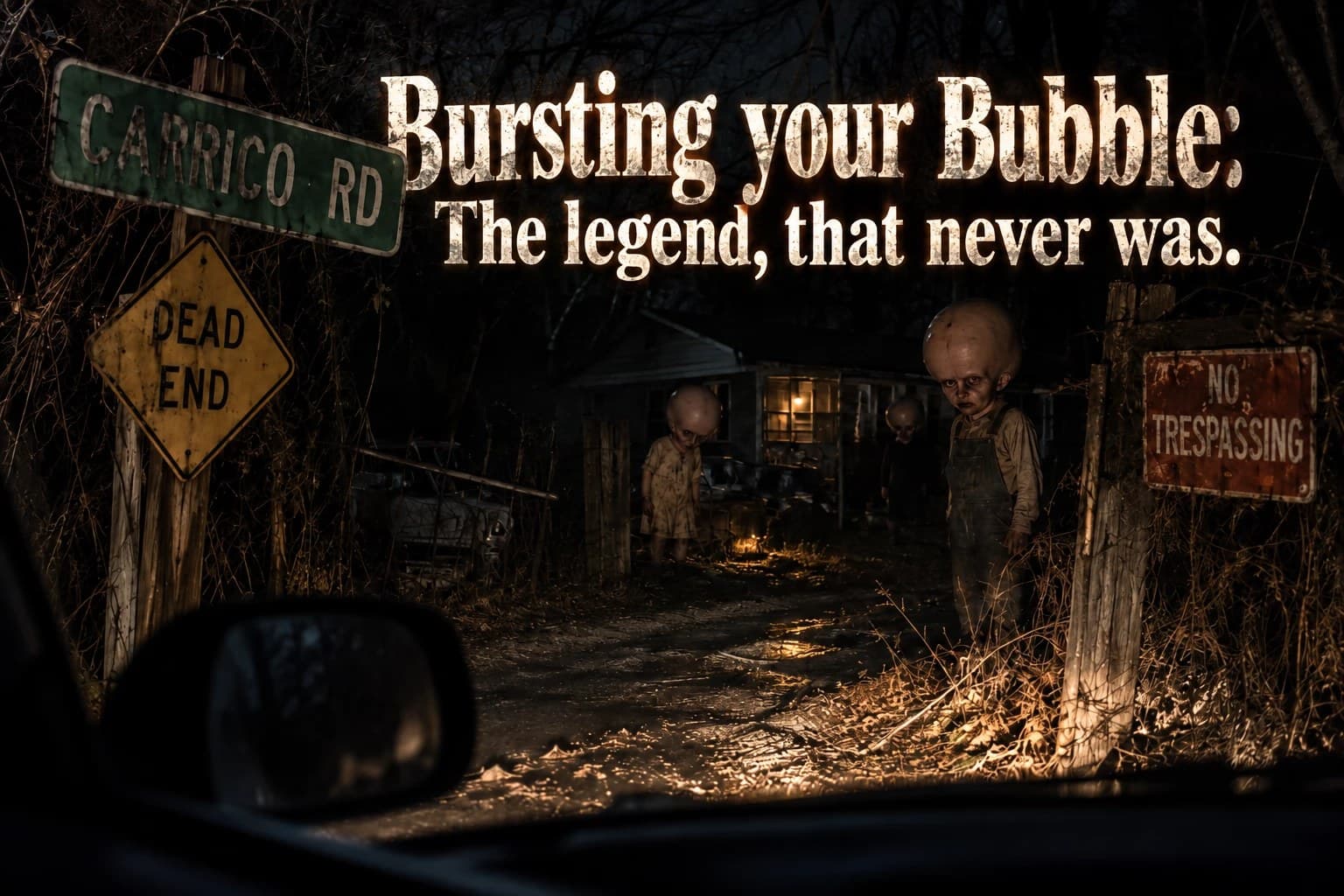
There is a dead-end lane in far North St. Louis County where teenagers have been killing their headlights for fifty years. Carrico Road winds through one of the last rural pockets of the metro, just south of the Missouri River near Sioux Passage Park, and it ends at a gate. At least eight signs along the shoulder say the same thing: no trespassing. Nobody who goes there calls it Carrico Road. They call it Bubblehead Road.
The ritual is always the same. You drive down after dark. You stop at the gate. You turn off the lights and wait. And then, if the story is to be believed, they come out of the trees: a family with heads swollen to the size of pumpkins, who either want to be left alone or want to tear you apart, depending on who is telling it.
Nobody has ever seen them. Everybody knows someone who has. That is how the story has worked since at least the 1960s, and it is exactly how a dozen podcasts, TikToks, and "haunted Missouri" listicles have retold it in the last five years, usually with the same confident voice and the same missing step: nobody picked up the phone, read the one piece of real reporting that exists, or asked who actually lives at the end of that road.
This is what they would have found.
The legend, as it gets told
There is no single Bubblehead story. There are four, and they cannot all be true, which is the first thing a careful storyteller would notice and the first thing most retellings skip.
- The experiment. A family took part in illegal drug trials. Their heads swelled "to the size of large pumpkins," in the phrase the Riverfront Times recorded in 2012. The government, or the pharmaceutical company, bought their silence with a piece of land at the end of an isolated road. This is the version that travels best, because it has a villain.
- The bloodline. An old St. Louis family whose generations of intermarriage produced hydrocephalus, "water on the brain," and enlarged skulls. No experiment, no cover-up, just a family nobody wanted to talk about.
- The escapees. A family that fled an insane asylum and vanished into the woods. First Alert 4 checked in October 2025 and found no record of any asylum ever operating in that part of the county.
- The mutation. The newest version, built for TikTok, blames Coldwater Creek, which runs about four miles south and really was poisoned with Manhattan Project uranium waste. The Bubbleheads become radiation victims. This version did not exist in the 2012 reporting. It was grafted on after the creek's contamination became national news.
On top of the four origins sits a layer of borrowed furniture: a hook man in the trees, a phantom hitchhiker, a moat around the compound, a road that "disappears from Google Maps," and a tie-in to the 1991 Dan Aykroyd film Nothing But Trouble because it has giant-headed characters in it. None of that is native to Carrico Road. All of it is standard-issue campfire material that attaches itself to any dark road with a gate.
The one thing every version agrees on is the ritual: drive down, kill the lights, wait. That ritual is older than any of the explanations for it. A forum poster in 2010 recalled a North County spouse who told the story and believed it back in the 1960s. The Riverfront Times put thrill-seekers on the road for "at least 40 years" as of 2012. Whatever happened at the end of Carrico Road, kids were already looking for it before the Apollo program ended.
What the podcasts got wrong
I went looking for the research behind the retellings. Here is the research. It fits on one screen.
THE CITATION CHAIN
one article, one Reddit comment,
a decade of retellings

2012  Riverfront Times
      the only on-the-road reporting
|
|- 2019  Ghosting Around podcast
|        source: RFT 2012
|- 2021  Afraid-ish podcast
|        source: RFT 2012, twice
|
|- 2021  KHMO radio blog
|        source: a Reddit comment
|  \- 2023  The Eagle
|        same author, recycled
|    \- 2024  Fox 2 / KTVI
|        cites RFT + The Eagle
|      \- 2024  Rizzuto Show
|        reads Fox 2's headline
|
\- 2014  concept trailer
   \- 2016  Blavity
        cannibals, invented

TikTok, 2023 on:
Coldwater Creek, the Google Maps
road, Nothing But Trouble (1991)
source: none
Two podcasts have given the Bubbleheads a full segment that I could find in Apple's index: Ghosting Around in February 2019 and Afraid-ish in April 2021, which promised to answer "What exactly is a Bubblehead?" over 64 minutes. Both list exactly one source for the Bubbleheads in their show notes: the 2012 Riverfront Times article. Afraid-ish lists it twice. That is not research. That is reading an article aloud. To their credit, they picked the right article. Nobody after them did.
The second branch is worse. In December 2021 a radio host in Hannibal published "The Sad Truth Behind Missouri's Urban Legend of The Bubbleheads," then recycled it in June 2023 as "Missouri's Legend of the Bubbleheads is True, Not What You Think." The sad truth, the hydrocephalus boy, is sourced to an anonymous Reddit commenter the author says outright he did not verify. The named neighbor who told the same story to the Riverfront Times nine years earlier, on the record, goes unmentioned. Then Fox 2 wrote it up in October 2024 citing the Riverfront Times and the radio blog, with no interviews of its own, and the Rizzuto Show put the Fox 2 headline in its rundown the next day. Four links in a chain and not one new phone call.
The third branch has no sources at all. TikTok added Coldwater Creek, Jamestown Mall, a road that "disappears from Google Maps," and a tie-in to a 1991 Dan Aykroyd movie. A St. Louis filmmaker's 2014 concept trailer, covered by Blavity in 2016, upgraded the family to cannibals. By 2018 even the Riverfront Times' own Halloween listicle was calling them "a family of genetic mutant bubbleheads," which means the paper had forgotten its own reporting in six years.
Claim by claim, here is how the retellings stack up against the record.
| What you have heard | Where it comes from | What the record says |
|---|---|---|
| A government or pharma drug experiment, family paid off | Recorded as lore by RFT in 2012; repeated by every podcast since | No agency, company, drug, document, or date has ever been named. Pure friend-of-a-friend. |
| They escaped from an insane asylum | YouTube explainers, TikTok | First Alert 4 checked in 2025: no asylum ever operated in that part of the county. |
| A family of genetic mutants, inbred for generations | RFT's 2018 listicle, the film pitch, countless retellings | Neighbors describe one child with hydrocephalus, a fluid condition, not a bloodline. |
| Cannibals | Jeffrey Thompson's 2014 concept trailer | Invented for a movie pitch. Appears nowhere before 2014. |
| Radiation from Coldwater Creek mutated them | TikTok, 2023 onward | Absent from every telling before the creek became national news. The creek is four miles away. |
| They chase and attack trespassers | Everyone | Fifty years, zero reports of an attack, chase, or injury. The only paperwork is trespassing tickets. |
| The road disappears from Google Maps | TikTok | It is on Google Maps. The radio blog used Street View for its photo. |
| The 1991 film Nothing But Trouble is based on it | TikTok | The film is set in New Jersey and written by Aykroyd. The legend predates it by twenty years. |
| The sad truth is a boy with hydrocephalus | Radio blogs citing an anonymous Reddit comment | Also said on the record by a named neighbor in 2012. Plausible, humane, and still unconfirmed. |
I have not sat through every hour of audio, and I am not going to pretend I have. I read what the shows said they relied on. When the research section of a true-crime episode is one link, you do not need the transcript to know what happened.
What the record actually says
There is exactly one piece of real reporting on the Bubbleheads, and it is thirteen years old. On October 25, 2012, Leah Greenbaum of the Riverfront Times drove out to Carrico Road, counted the signs, and knocked on doors. Everything credible that anyone has said about this legend since then traces back to that article. Most of the people repeating it have never read it.
Here is what she found.
A neighbor who remembers a boy. John Goessmann, who inherited an old farmhouse on Carrico from his aunt and uncle, told Greenbaum he remembered a boy who lived at the far end of the road "a long time ago." The boy had hydrocephalus, a buildup of fluid in the brain that enlarges a young child's skull. He supposedly played outside wearing a helmet to protect his head. Goessmann and others on the road said the family moved away long ago, probably to get some privacy.
A folklorist who recognized the pattern. Dr. John L. Oldani, a retired Southern Illinois University Edwardsville professor who studied regional folklore for decades, told her the Bubbleheads are a textbook friend-of-a-friend story. "People will keep telling these stories, but it's always going to be a friend of a friend, maybe someone they know but can't name, who saw the Bubbleheads themselves."
A cop who wrote the tickets. Randy Vaughn, then a media-relations officer for St. Louis County Police, patrolled the area in the 1990s. "We've issued so many tickets and violations out of there over the years. Kids won't leave it alone, especially in summertime and around Halloween."
A homeowner who wanted his name left out. A couple of times a year, he said, he wakes at 2 a.m. to a car stereo at full volume or tires squealing at the gate. "I know those are kids out there messing around, looking for the Bubbleheads."
That is the whole evidentiary record. One secondhand memory of a sick child, one folklorist, one police officer, one tired neighbor.
Thirteen years later, First Alert 4 went back and got the same story from author Troy Taylor, who added that the taunting of the boy is what turned "bubblehead" from a slur into a monster. Then the station did something nobody else had bothered to do. It tried to confirm the boy existed. It could not. In its own words, it "has not found anyone known to have hydrocephalus living on Carrico Road."
So the honest state of knowledge is this. The hydrocephalus explanation is plausible, it is humane, and it is what the people who actually live there believe. It is also unverified oral history. The experiment, the asylum, the inbreeding, and the uranium are not even that. They are decoration.
And one more thing the record does not contain: a single documented attack, chase, injury, or police report involving anyone coming out of those woods. Fifty years of teenagers, and the only people who ever got hurt were the ones who got tickets.
The real victims live at the end of the road
Strip away the pumpkin heads and what is left is a story about a neighborhood that has been harassed for half a century over a rumor.
The people on Carrico Road are not a mystery. They are retirees, farm families, and the owners of a few newer houses in the Carrico Woods subdivision. They have cameras now. One resident wrote on a local photo blog that "there's nothing down here and no reason to trespass because we have cameras," and that county police "show up right away when we call about the trespassing Bubblehead idiots." Another warned flatly: this is a private road, and you will be arrested.
They are not exaggerating. The county police officer who patrolled the road in the 1990s described writing "so many tickets and violations out of there over the years" that he lost count. The surge comes every summer and every October, when a new class of sixteen-year-olds gets their licenses and hears the story for the first time.
And then there is the boy.
If the neighbors are right, the whole legend grew out of a child with a medical condition, playing in his own yard in a helmet, being spotted by passing kids and turned into a slur. The family left to escape it. Every podcast that describes "a family of genetic mutants" or "inbred cannibals" at the end of Carrico Road is, without knowing it, repeating that slur into a microphone fifty years later. A radio host in Hannibal who looked into it in 2021 reached the only sane conclusion: "This is one Missouri urban legend that really needs to go away."
It will not go away. Legends do not. But the people who tell it for a living could at least tell it straight: there was no monster, there was no experiment, there was a kid, and the people who live there now would like you to stop driving down their road at 2 a.m.
Why North County, and what to do about it
It is not an accident that the cover-up version of this story took root where it did. North St. Louis County is the one place in America where "the government hid something toxic in your neighborhood and lied about it" is not a legend. It is the Coldwater Creek story, and it is documented in federal cleanup records, cancer studies, and a decade of front-page reporting. When people who grew up a few miles from that creek tell you a family was poisoned and paid off, they are not being gullible. They are pattern-matching on something that actually happened to them.
That is exactly why the people who tell these stories for a living owe the subject more than a listicle. Every lazy retelling of the Bubbleheads borrows credibility from a real injury and spends it on a fake one.
We investigate places like this. Emmaus Village has four cemeteries, a crematorium, and a century of institutional records, and the first thing we did was read them. Not because the records make the place less interesting, but because the records are where the actual story lives. An investigation that starts from a listicle is not an investigation. It is content.
So here is what responsible storytelling about Carrico Road looks like.
- Read the 2012 article. It is thirteen years old, it is still the only real reporting, and it takes ten minutes.
- Say what is verified and what is not. A named neighbor's memory is evidence. An anonymous Reddit comment is not. Say which one you are repeating.
- Do not give directions. The residents have cameras, a police response, and fifty years of ruined sleep. The address does not belong in your episode.
- Lead with the kid. If the legend is about anything, it is about how a neighborhood treated a disabled child. That is a better story than pumpkin heads, and it has the advantage of possibly being true.
The Bubbleheads will outlive everyone who reads this. Legends do. But the next time a podcast promises to tell you what exactly a Bubblehead is, check the show notes first. If there is one link, you already know.
Sources
| Date | Source | What it adds |
|---|---|---|
| Oct 10, 2025 | First Alert 4, STLegends: Bubbleheads of North County | Troy Taylor interview; checked the asylum claim; could not confirm a hydrocephalus case on the road |
| Oct 16, 2024 | Fox 2 / KTVI, The 'Bubblehead family' in Florissant | Cites RFT and The Eagle; no original interviews |
| Jun 4, 2023 | 100.9 The Eagle, Missouri's Legend of the Bubbleheads is True | Hydrocephalus account sourced to Reddit |
| Dec 16, 2021 | KHMO, The Sad Truth Behind Missouri's Urban Legend of The Bubbleheads | Same author, same Reddit source; "this legend needs to go away" |
| Apr 18, 2021 | Afraid-ish, MO Pt 4: MOMO, Zombie Road, Bubbleheads | Show notes list the 2012 RFT article as the only Bubblehead source |
| Feb 13, 2019 | Ghosting Around, Ep 29: St. Louis, Missouri | Show notes list the 2012 RFT article as the only Bubblehead source |
| Jun 29, 2018 | Riverfront Times, St. Louis' Creepiest Urban Legends | "Genetic mutant bubbleheads"; drops the paper's own 2012 reporting |
| Jan 14, 2016 | Blavity, concept trailer for The Bubbleheads: Legend of Carrico Road | Jeffrey Thompson's film pitch; the cannibal version |
| Oct 25, 2012 | Riverfront Times, Five St. Louis Ghost Stories That Just Won't Die | Leah Greenbaum's on-the-road reporting: Goessmann, Oldani, Vaughn, the anonymous homeowner |
| Jul 2010 | Underground Ozarks forum thread | First-hand drive-down accounts; a recollection of the legend from the 1960s |
| undated | St. Louis Patina, Far North County Adventures | Carrico Woods residents on cameras, police response, and trespassers |
| Oct 2024 | St. Louis Magazine, Emmaus Village hopes to become Missouri's new paranormal destination | Background on Emmaus Village |